







Published: January 27, 2026
Federal Initiative to Address Unsheltered Homelessness Shows Promise
A snapshot of progress in year 1 of HUD’s Special NOFO
to Address Rural & Unsheltered Homelessness

Table of Contents
The United States faces a crisis of rising unsheltered homelessness that has been years in
the making. A unique federal initiative, still in its early stages, offers a glimpse of how communities
can respond when given flexible resources to pursue strategic investments in
housing and services.
In spring 2023, the U.S. Department of Housing and Urban Development (HUD) announced
first-of-its-kind funding to address unsheltered homelessness (the Special Notice of Funding
Opportunity to Address Rural and Unsheltered Homelessness, or Special NOFO). HUD awarded
three-year grants to 32 communities across the country through a competitive process.1
Winning Continuums of Care (CoCs) had undertaken extensive data analysis and community
engagement to diagnose their needs and formulate an action plan using evidence-based
strategies and emerging promising practices. Communities could fund 1) housing with services
or 2) services-only projects (largely in alignment with the existing CoC Program structure:
see section below) and most selected a mix of both housing and services projects.
Grantees began implementing in the summer of 2023, with most projects underway by early 2024. Although the three-year implementation period begins with an individual grant’s start date, for simplicity’s sake, this and future reports follow the federal fiscal calendar. Year 1 therefore includes activities up until September 30, 2024.
The Alliance continues to reach out to all 32 communities that received funding through the unsheltered set-aside to participate in ongoing research. This brief draws on interviews completed with CoC lead agency and service provider staff representing 24 CoCs in spring 2025 and aggregate project-level data from Annual Performance Reports (APRs) shared by 22 CoCs.2 This represents an early and incomplete picture of progress across grantees. Research is ongoing as grants continue, and future work will seek to incorporate broader perspectives on implementation. The Alliance is grateful to participating communities for sharing their time and expertise so that others may learn from their work.
Responding to Unsheltered Homelessness with Housing and Services
Most recipient CoCs opted to fund a mix of housing and services projects, with the common goals of :
- identifying people experiencing unsheltered homelessness, assessing their needs, and bringing services (like healthcare) directly to them, all in a coordinated manner;
- connecting people with permanent housing as quickly as possible, such as by moving all residents of an encampment into their own homes; and
- expanding rental subsidies and services capacity to be able to house and support more people, including through medium- and long-term interventions.
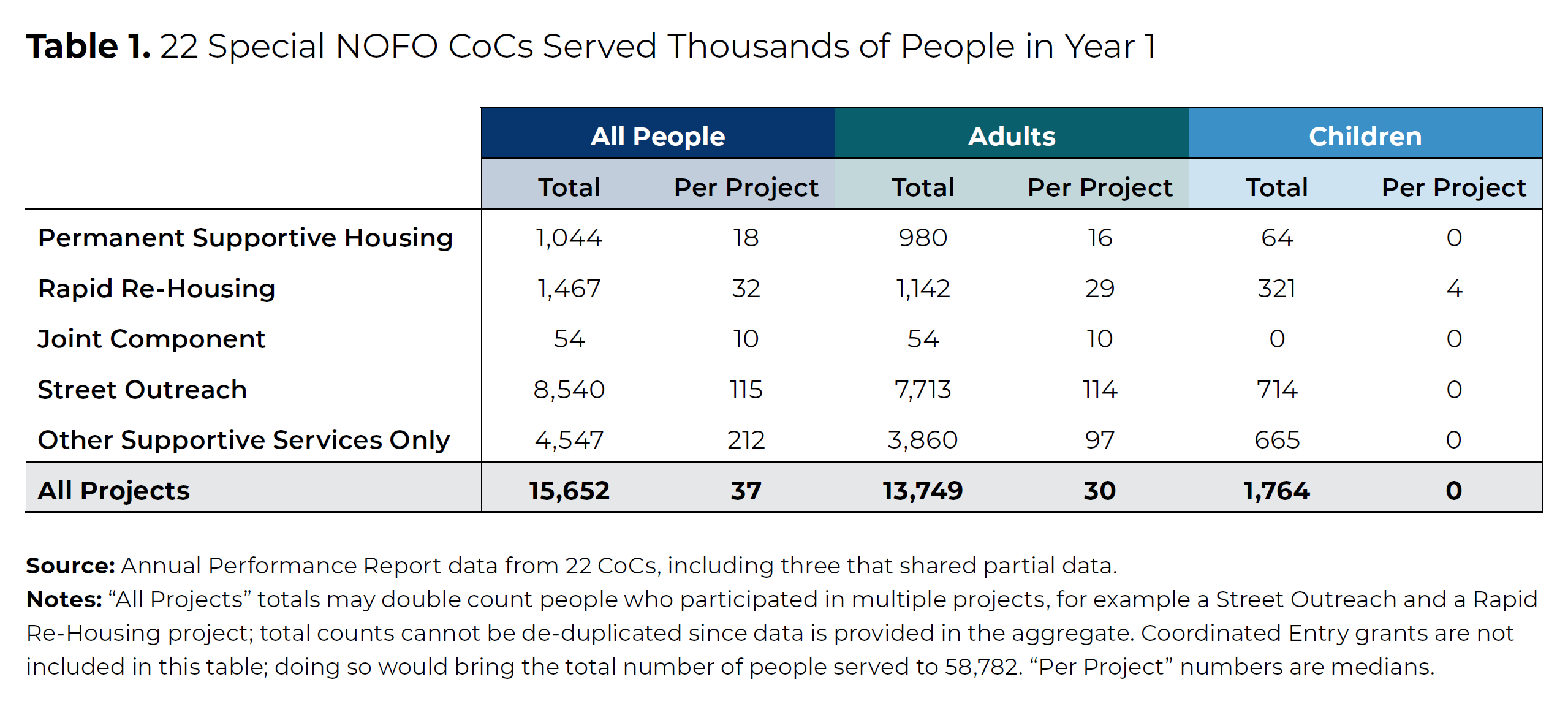
In year 1, Special NOFO projects served at least 15,000 people across all project types (Table 1). Since data is only available for about two-thirds of projects, the actual total is very likely to be over 20,000. Most people served were single adults, but projects served a significant number of families — including children — as well.
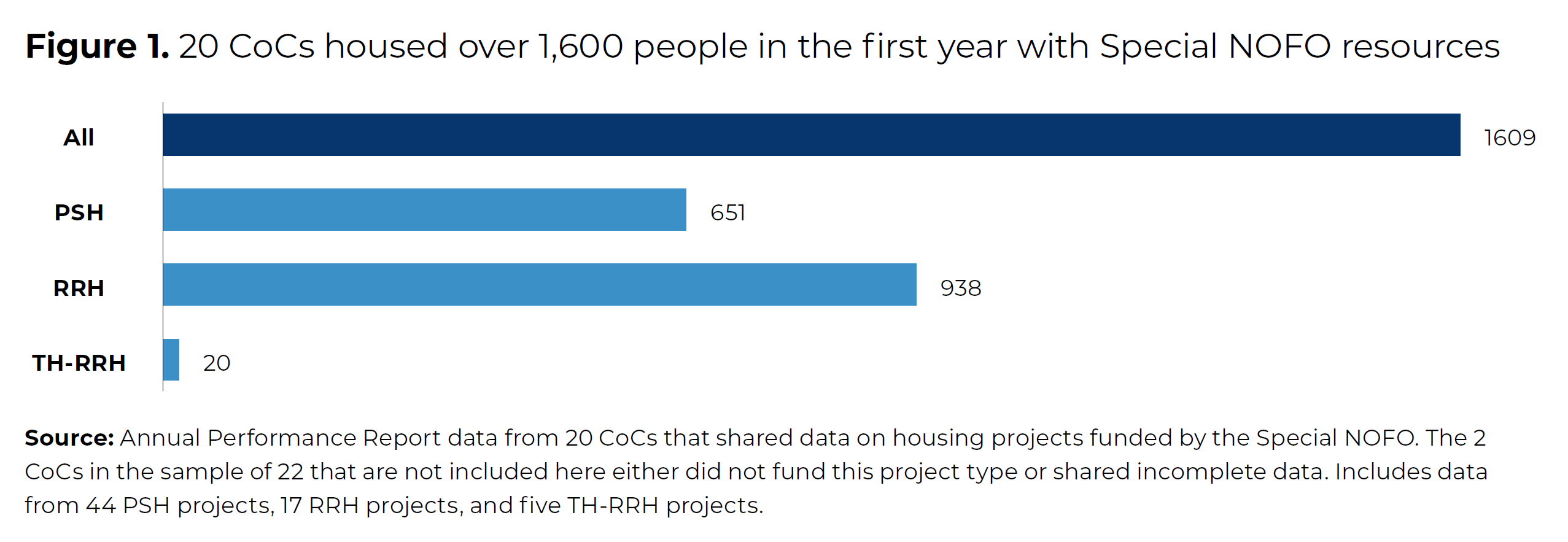
More than 1,600 people in 1,200 households, including more than 100 families with children, moved into housing through PSH, RRH, or TH-RRH projects (Figure 1). People moved into their new homes relatively quickly: the time from project enrollment to housing move-in tended to take about 40 days.
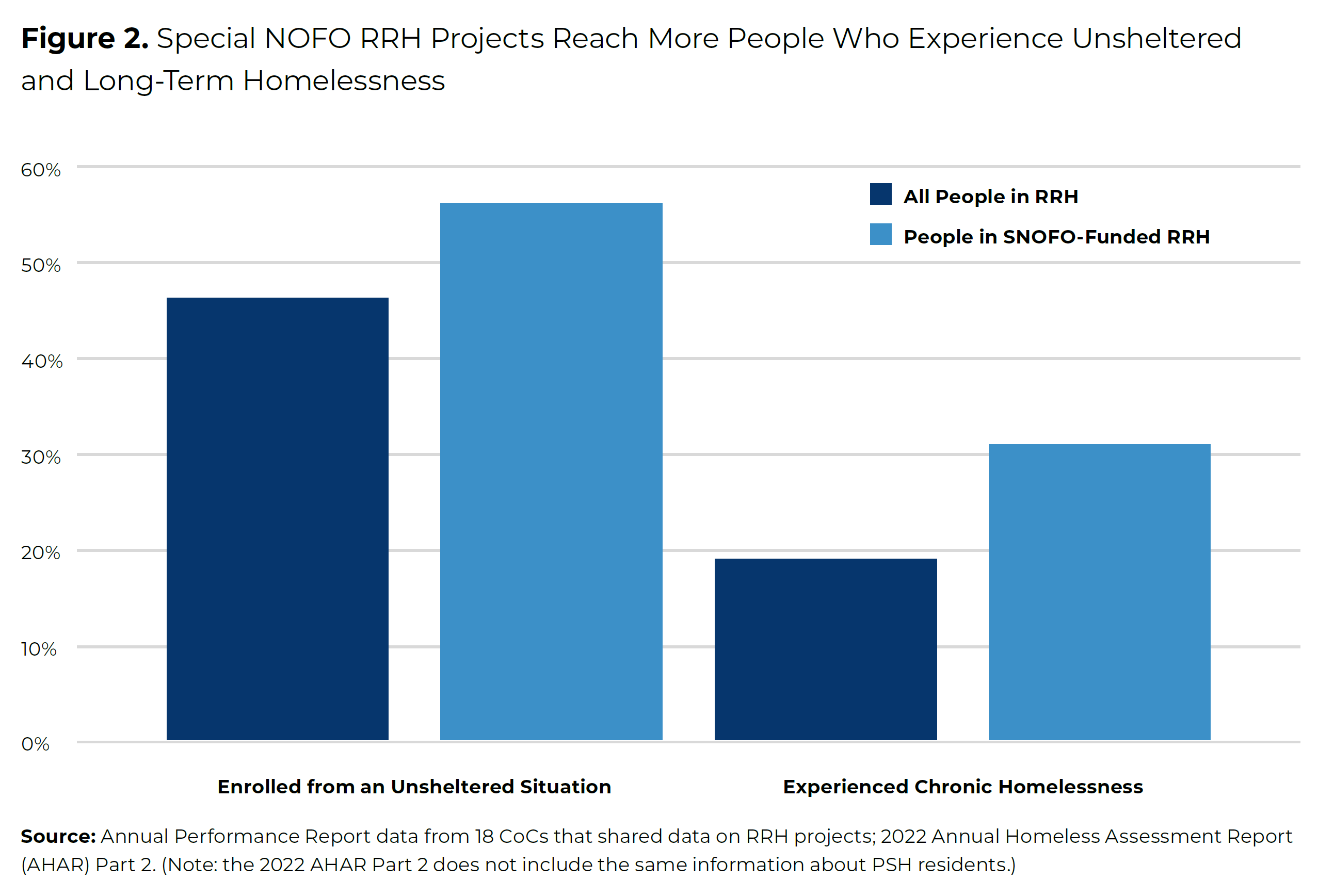
RRH projects often served more people than PSH projects, but fewer RRH participants came directly from unsheltered situations or had experienced homelessness for a long time. Because of the population they served, providers often designed PSH projects to include strong ties to healthcare. For example, some brought services on-site at apartment buildings, and some sought to bolster case management through teams trained in Assertive Community Treatment (ACT), Critical Time Intervention, or peer support.
Supportive services like street outreach also helped people exit unsheltered homelessness and enter housing. Special NOFO projects enabled CoCs to better coordinate outreach efforts and conduct outreach to their full geography, including rural areas they hadn’t previously been able to serve. Several projects brought specialized services to people, including substance use treatment, peer support, and healthcare like wound treatment, psychiatry, and medication management.
By the end of the fiscal year, more than half of people engaged by street outreach remained active with their case manager and about 15 percent exited unsheltered homelessness into some form of shelter or housing. This includes more than 800 people who moved into a unit of their own, often with a housing voucher (like the Stability Vouchers HUD allocated to Special NOFO communities) or through a permanent housing program (like PSH) that provides ongoing services as well as rental assistance. The lack of resources for shelter beds, permanent housing programs, and public/other assisted housing in communities across the country constrain street outreach providers from helping more people enter housing.
HUD intended the Special NOFO to serve people with “severe service needs” and address unsheltered homelessness. Project data shows that communities are indeed housing a sizeable number of people in RRH, PSH, and other housing directly from encampments and other unsheltered locations. Across grant types, about 60 percent of people served had most recently been residing outside. Likely, many more had experienced unsheltered homelessness at some point in their lives. Additionally, nearly half of households served had at least one chronically homeless member. These rates are higher than usual: for context, 46 percent of people nationally enrolled in RRH from an unsheltered setting and 19 percent had at least one chronically homeless household member (Figure 2).
Improving a Comprehensive Response to Unsheltered Homelessness
CoCs are not funded at a level that would enable them to help everyone experiencing homelessness within their jurisdiction. Consequently, the extent to which CoCs can strategically and proactively respond to unsheltered homelessness varies significantly. The Special NOFO changed this by providing funding specifically for this purpose. While recipient communities feel the impact differently depending on how they’re using this funding and the amount of their award relative to the size of their unsheltered population, some themes are emerging across the board.
CoCs are reaching more unsheltered people and serving them better.
CoCs that reported the largest impacts from this funding so far tended to either be:
- Communities that are activating a coordinated response to unsheltered homelessness: Previously, some CoCs — especially those in rural or suburban areas — had very little or no resources to respond to unsheltered homelessness. Special NOFO funding enabled these CoCs be proactive and strategic by adding staff capacity, coordinated street outreach teams, and specific pathways to housing for people who are outside.
- Communities that are implementing place-based approaches to housing people from unsheltered homelessness: Some CoCs are using Special NOFO funding to identify and prioritize encampments and other groups of people experiencing unsheltered homelessness for access to housing (see Tucson/Pima County CoC section below). While some CoCs are adding this approach for the first time, others are using this funding to augment existing place-based work.
Even CoCs that do not fit neatly into either category received new resources to primarily serve unsheltered people in their jurisdictions. As a result, CoCs can provide services to more unsheltered people and do so more efficiently.
CoCs are working to reduce the length of time it takes to house unsheltered people.
Across the board, most interviewed CoCs noted either new (nine CoCs) or improved (seven CoCs) coordination around unsheltered homelessness due to the Special NOFO, often involving better data tracking and new cross-agency partnerships.
Several CoCs made updates to their identification and assessment protocols to clearly define roles, responsibilities, and timelines, to ensure people are connected with resources as efficiently as possible. Regular case conferencing meetings, sometimes called “housing solutions meetings,” are a common feature across communities and are an important venue for brainstorming and accountability. As one interviewee said: “The meeting is not about the people on the list — it’s about the people in the room connecting with each other, to serve the people on the list better.” A few CoCs implemented teams of “housing navigators” whose role is to assist people during the transition from street outreach to a housing program.
Across the board, this laser-focus on creating movement through the system — backed by new resources to help make these changes — is reportedly resulting in faster housing move-ins. Some CoCs are already seeing the results in their data.
Because of these system improvements, CoCs are reducing jurisdictions’ reliance on criminalizing homelessness — or are at least mitigating its harms.
CoCs with robust street outreach and a plan to address unsheltered homelessness can position themselves as the trusted partner in charge of the response. Multiple CoCs noted how the Special NOFO funding enabled them to take on this role, which likely otherwise fell onto law enforcement or other emergency services. Now, homeless services providers serve as the clear point of contact when city partners or concerned citizens identify unsheltered people. As one CoC lead remarked, “without outreach to respond, all [municipal leaders] have to do is arrests.”
Outreach workers and behavioral health specialists — experts on assisting people experiencing challenges while living unsheltered — take the lead and align their efforts with law enforcement, public works, and fire and rescue. All actors are focused on helping people move into housing. When possible, these relationships benefit everyone: reducing the amount of time and resources other systems spend on homelessness and enabling homeless service providers to be able to do their jobs of rehousing people without interference.
Challenges from Capacity Constraints
Recipient CoCs faced hurdles getting projects off the ground. Now, in the midst of implementation, they face challenges common within homeless services: tight rental markets and not enough staff capacity.
Challenging start-ups
Special NOFO grants represented an often significant departure from usual business, involving new provider organizations and/or grant types, requiring policy changes, and necessitating hiring and training of new staff — all at a time when homeless services providers were stretched thin. In interviews, CoC leads shared stories of start-up challenges compounded by each other, sometimes delaying projects for months. Still, interviewees were hopeful that the up-front investment would pay off in the long run, such as by bringing in new providers to the CoC or by articulating new program models or referral pathways. CoCs that were able to start faster were either building off existing programming or took a strong leadership role in implementation. For example, some CoCs made policy decisions before receiving word they had won the grant, and then worked to compile start-up checklists, hold launch meetings, and institute frequent check-ins with grantees.
Even for projects with grant start dates in 2023, client enrollment may not have started until 2024. Thus, this report presents a limited window into the actual first year of project implementation.
Constraints continue due to local capacity, housing market conditions, and criminalization threats.
Homeless services are commonly challenged by the scarcity of available affordable units and robust community services. One community observed that it took more than 100 days to find a unit someone could move into with their PSH or RRH rental subsidy because these units were so scarce. These challenges are amplified when serving people who have been outside the longest and have complex health needs. Some people engaged by Special NOFO projects had never worked with a service provider before. Others had been housed by CoC providers before but then returned to homelessness. Building trust and addressing barriers to housing, like lack of income and documentation, can take time — often longer than providers might like. Once housed, service providers sometimes struggled to maintain sufficient support for their clients. Adding staff capacity like Critical Time Intervention specialists or housing navigators — which communities were able to do with this funding — helped to address these challenges, but CoCs could benefit from an even more robust landscape of services.
Laws that criminalize homelessness make it harder for homeless service providers to do their work. The success of street outreach relies on repeated engagement, which is difficult when people are constantly forced to move along or go into hiding to avoid punishment. Some CoCs reported that their unsheltered population — including whole encampments — have been more mobile recently due to ramped-up enforcement efforts. Politicization of the issue also gets in the way by introducing pressures that can be counterproductive to CoCs’ work, for example by diverting resources to respond to public complaints.
Sustained investments in proven housing-focused approaches are necessary to make measurable progress towards ending unsheltered homelessness.
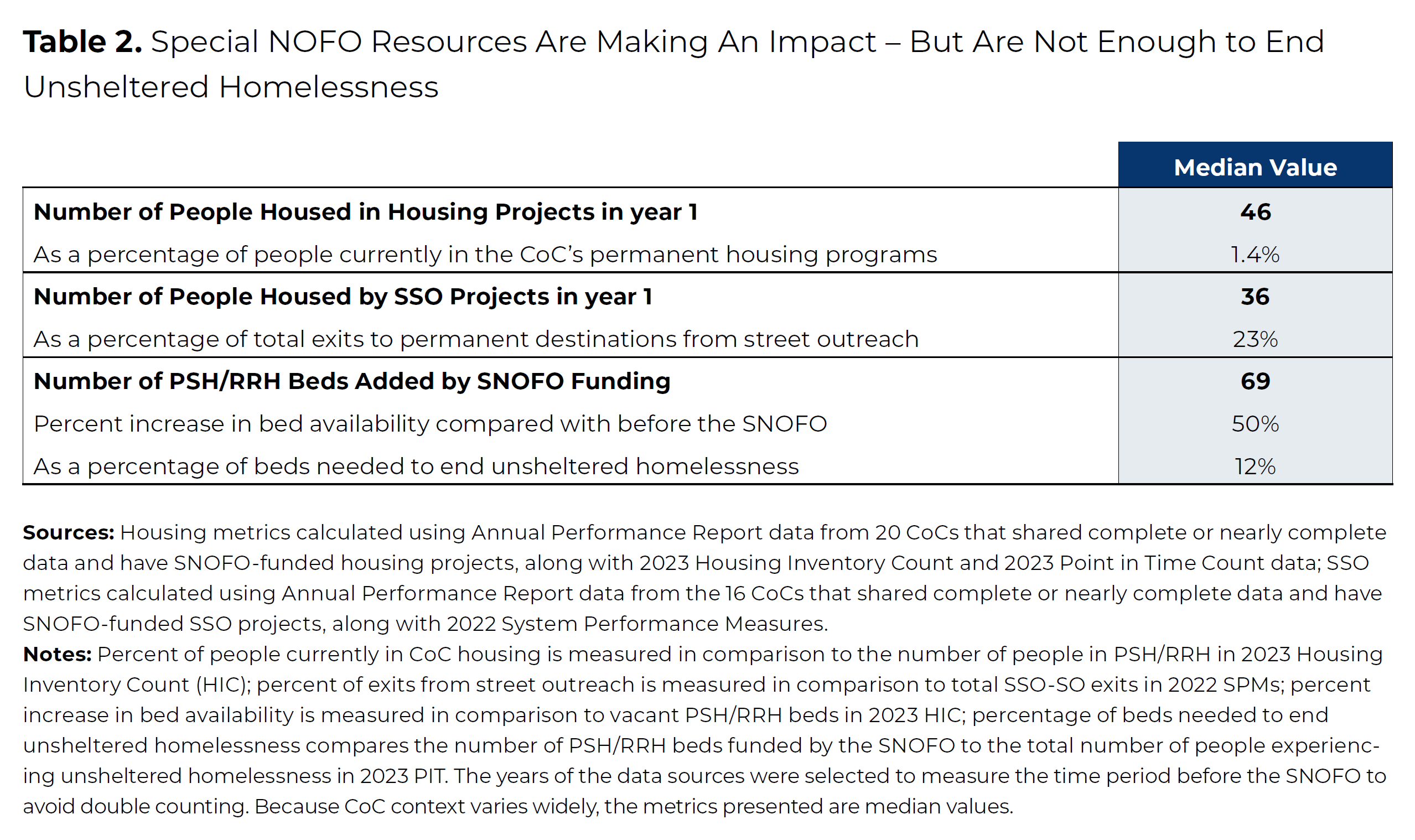
Communities are using the Special NOFO to house more unsheltered people than they otherwise would have been able to. CoCs that received Special NOFO funding tended to add 69 housing slots, and in the first year, house about 46 people in housing projects and about 36 people through SSO projects (Table 2). This is a significant change in CoC housing opportunities, representing an increase of about 50 percent (the median value across CoCs) in their available housing program slots.
However, it is important to be clear-eyed about what this funding means: it was never enough to end unsheltered homelessness in these communities. The number of beds added is a tiny proportion of the number of people these CoCs are currently supporting in housing programs. Additionally, this funding is only providing a fraction of the housing slots needed to end the homelessness of every person identified as unsheltered in the 2023 Point in Time Count — across CoCs, about 12 percent.
So, while these investments are transforming the lives of people who are housed by them and providing proactive alternatives to criminalizing homelessness, this three-year investment was never enough to end unsheltered homelessness in these communities, even assuming that unsheltered population counts remained the same. Unfortunately, many communities report seeing more and more people fall into homelessness.
Still, the impact of these grants is important and projected to grow overtime. Communities invested significantly in strategic planning to win these funds. Now, they have also spent time articulating new program models, building new partnerships, and hiring and training new staff. CoCs ended the first year looking forward to additional progress they could make in years 2 and 3: fully leasing up housing projects, monitoring client data and spend down, making adjustments to ensure peak performance, and continuing broader systems-improvement work. These changes have spillover effects, improving how CoCs are operating as a whole.
The year 1 data from these communities is promising. A stable federal funding environment that prioritizes proven housing-focused solutions is necessary to sustain progress. Federal funding for homeless assistance, especially investments in solutions that prioritize access to permanent, stable housing, often faces threats despite substantial proof that these approaches work to end homelessness. This instability jeopardizes communities’ ability to plan for the future and build on their successes. The federal government has the potential to learn from the communities it funded through this initiative. Projects that are working to bring housing and services to unsheltered people should receive ongoing funding. Additional funding could enable these CoCs to bring promising practices to scale and other CoCs to replicate these strategies. If it is sustained and expanded, this initiative has tremendous potential to help communities across the country reduce unsheltered homelessness.
The Alliance will continue following these communities’ progress to inform policymakers and practitioners seeking a better approach to unsheltered homelessness.
Endnotes
- An additional 30 communities won funding to address rural homelessness. This report focuses
on the communities that received funding through the unsheltered set-aside. ↩︎ - Of the 22 CoCs that shared APRs, 19 submitted full data, 2 shared data on most of their projects, and 1 shared data on 1 project. In total, CoCs shared data on 114 grants, representing 66% of total grants. Participating communities were largely representative of the whole group of awardees, with a slight underrepresentation of major cities on the West Coast receiving high amounts of funding. ↩︎
Interested in
learning more?
Subscribe today to stay informed and get regular updates from the Alliance.
[The Special NOFO funding] has been huge: adding [to] the number of rental assistance units, to me, it makes so much difference. It’s frustrating when you have someone who is in a really bad way, homeless, health problems, other reasons where it’s a really hard situation, and you can’t do anything. You know they’re on the street carrying around their oxygen tank. I’m very thankful to have this funding so that we can give immediate service to them.”
Service provider staff