







Summary
PDA, a service provider in Washington state, has been experimenting with workforce policies that include living wages, expansive benefits, and various work supports. This evaluation of their approach reveals that PDA employees have high job satisfaction compared to other non-profit workers. 89 percent say they want to stay in their job for at least one year. Clients say they benefit from low staff turnover. Such stability among direct services staff is key in this field where outcomes are driven by quality staff/ client relationships. Such efforts could turn the tide on prevalent homeless services workforce challenges, including high turnover and unfilled positions.
In recent years, some homeless services providers have been testing promising new approaches to workforce recruitment and retention. Their goal is to boost employee job satisfaction in ways that translate into improved client outcomes. These efforts respond to ongoing workforce challenges, including staff turnover, vacancies, and burnout. Recent research from the National Alliance to End Homelessness and academia has linked these pressures to low pay, stressful working conditions, and limited organizational supports.
The Alliance seeks to understand promising practices at different organizations throughout the country. We begin with an analysis of Purpose. Dignity. Action. (PDA), a service provider in Washington state. We limited the focus of our evaluation to the organization’s workforce policies.
The PDA Approach and Evaluation
In its efforts to attract and retain staff that are the best match for available positions, PDA provides the following:
| PDA’s Approach to Retention: Salary, Benefits, and Other Workplace Factors | |
| Living wages competitive with other local employers (including government agencies), ranging from $75,000 – $147,000 | 15 days of vacation in their first year, increasing incrementally to a maximum of 20 days, and 12 paid holidays annually |
| Transparent salary scales with automatic annual step increases for up to 10 years | Sick, Safe, and Personal Leave is front-loaded at up to 12 days per year and can be used for both physical and mental health needs |
| Regular Cost of Living Adjustments | Formal wellness initiatives, including facilitated peer support groups, reflective wellness communications, and access to an Employee Assistance Program |
| 100% employer-paid medical and dental coverage for both employees and their dependents | Limited caseloads (12 participants per staff member) |
| Fully employer-paid life and disability insurance | Largely mid-career team with previous lived experience and relevant professional experience |
| 401(k) plan with 4% employer match |
In conjunction with a consultant from the University of Washington, the Alliance team assessed the effectiveness of these policies. We surveyed and interviewed 26 PDA staff to assess their job satisfaction, desire to stay employed at PDA, opinions on workplace supports, and other factors. We also interviewed 14 PDA clients to understand how the organization’s workforce policies are impacting the people being served.
Why Job Satisfaction and Retention Matter
While many homelessness programs are judged by their ability to house people, their success can also be defined by the relationships between staff and residents. Services are voluntary, and previous research has shown that progress is driven by trust, accountability, and ongoing interpersonal connection. Supporting this conclusion, the majority of PDA’s staff (85 percent) agreed that clients have better outcomes when they have consistent contact with the same employees.
Homeless Service Work = Relationship First
The findings from this study suggest that staff derive meaning from witnessing improvements in residents’ quality of life, while residents interpret consistent staff presence as evidence of care and reliability. Rather than viewing housing as a discrete intervention, both groups describe it as embedded within a broader relational process. Within such a model, turnover is not merely an administrative challenge; it risks disrupting the relationships that underpin effective homeless service delivery.
| Client Engagement and Continuity of Care | |
|---|---|
| Category | # of People |
| Length of Time Connected to PDA | |
| 1–3 Months | 1 (6.3%) |
| 4–6 Months | 5 (31.3%) |
| 7–12 Months | 3 (18.8%) |
| 1–3 Years | 7 (43.8%) |
| Meetings with Staff in Past 3 Months | |
| Once | 1 (6.3%) |
| 2–3 Times | 2 (12.5%) |
| 4–6 Times | 2 (12.5%) |
| 7 or More Times | 11 (68.8%) |
| Continuity of Staff Contact | |
| Mostly Same Staff/Team | 12 (75.0%) |
| Some Changes | 1 (6.3%) |
| Worked with Many Different Staff | 3 (18.8%) |
Client Voices: How They Experience PDA Staff
Residents described staff relationships as central to their experiences within the program, often linking consistent engagement with changes in personal stability and well-being. In some cases, residents described how supportive relationships with staff helped them distance themselves from harmful environments or survival strategies associated with homelessness.
Nearly half of respondents had stayed connected to the program for one to three years, while others were in earlier stages of their relationships with the nonprofit. Most reported frequent interactions with staff, often seven or more times in the past three months. This consistency, along with stable relationships with the same staff, suggests the program is built on ongoing, relationship-based support rather than short-term or fragmented care.
“They do an amazing job down here… they really cover everything, every base that we need down here… I chose to take advantage of this program, and it’s working out for the best. You know, I found a job. I quit using drugs… I got, like, over a year and a half of sober being off… fentanyl, meth and alcohol.”
Employee Voices: Intentions to Stay
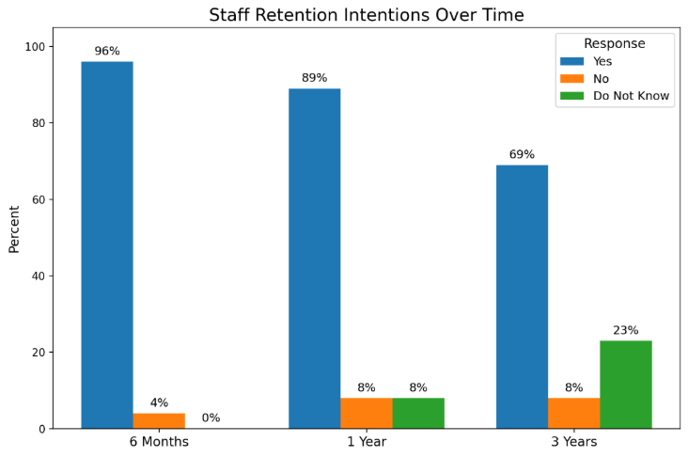
Staff in this study reported high levels of overall job satisfaction and strong short-term intentions to remain employed. Nearly all staff indicated that they expected to remain in their positions over the next six months (96 percent), and a large majority reported plans to remain for at least one year (89 percent). While intentions declined somewhat over longer time horizons, more than two-thirds (69 percent) still reported that they would like to remain employed at the organization three years from now.
“Great medical benefits… this is the highest paying job that I’ve ever had… to have a living wage is an amazing thing. For so many years, I was doing the same kind of work and I was paycheck to paycheck… I was always one paycheck away from actually being in the same situation that my clients were… Our benefit package is great… I’ll never complain about the amount of money that we get or our benefits. We’re well taken care of, as far as I’m concerned.”
Employee Voices: Job Satisfaction and Well-Being
Staff completed the 36-item Job Satisfaction Survey (JSS), a validated tool commonly used by researchers that measures nine aspects of job satisfaction. In general, PDA employees expressed a notable amount of positivity about their jobs. Their average overall JSS score (156) was higher than the known norms for social services workers (142.9) and nonprofit workers (136.8). PDA employees also scored above the norms for attitudes toward their pay and benefits, validating the organization’s emphasis on living wages and generous benefits as means of improving employee job satisfaction.
| Job Satisfaction Survey (JSS) (Completed by 26 PDA Employees) | |||
| Average Score | Observed Range | Possible Range | |
| Overall JSS Survey | 156.00 | 95–192 | 36–216 |
| Subcategories | Average Score | Observed Range | Possible Range |
| Nature of Work | 20.50 | 11–24 | 4–24 |
| Supervision | 20.00 | 8–24 | 4–24 |
| Benefits | 19.58 | 13–24 | 4–24 |
| Pay | 18.96 | 12–24 | 4–24 |
| Coworkers | 18.42 | 11–24 | 4–24 |
| Promotion | 14.92 | 4–24 | 4–24 |
| Rewards | 14.62 | 10–19 | 4–24 |
| Operating Procedures | 14.62 | 8–22 | 4–24 |
| Communication | 14.38 | 5–23 | 4–24 |
PDA employees expressed the highest level of satisfaction with the nature of their work. This suggests that the organization is successfully identifying mission-driven people to join its staff. Within the non-profit sector, conventional wisdom holds that these individuals are highly valuable. Future research could more formally explore whether this factor improves client outcomes and organizational success. Importantly, employers may not want to invest too much in retention if they are not hiring mission-driven, committed workers.
PDA employees were least satisfied with operating procedures and communication. As one staff member put it, “I think there’s been like, seven directors since I started years ago… every time somebody new comes in, we do things new, and sometimes that can be a lot of stress. That was stressful, it can be stressful, right?” Through interviews and discussions, the organization’s leaders highlighted factors that may have impacted these results. For example, there were funding losses and related disruptions, including a decision to prioritize direct services jobs over those of middle management. The organization was also willing to try many new things while readily ending policies that weren’t working. Leadership acknowledged that management changes and shifting policies may have caused some confusion within their workplace. These factors may have played a role in employee responses to the survey (although the research team cannot independently verify that conclusion or version of events).
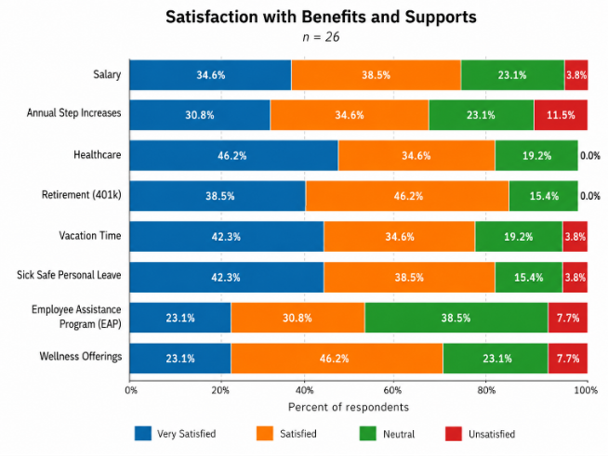
Staff also reported generally positive satisfaction with benefits and workplace supports, particularly around healthcare, retirement, vacation time, and Sick Safe Personal Leave. However, responses were less enthusiastic about annual step increases, the Employee Assistance Program, and wellness offerings. These findings suggest that 1) staff value certain offerings more than others or 2) improvements in some offerings may further increase their value to employees.
Since salary levels are prominent in existing research, staff were asked questions about that issue that extended beyond the JSS. One hundred percent said their salary was “Important” or “Very Important” to their desire to continue working at PDA. This factor notably impacts quality of life and well-being. Roughly, 1 in 4 said their wages were “life changing”. Further, compared to just 14 percent of people in a nationwide survey of the homeless services workforce, 62 percent of PDA employees said their income allows them to “live well” with overwhelming majorities being able to afford basics and extras such as medications, weekend activities, and desired clothing and home furnishings and decorations.
Finally, at least one other theme emerged: the central importance of relationships extends beyond client work. For staff, co-workers and leadership are significantly important. When asked about a list of factors that help them manage stress and challenges, PDA staff ranked support from their supervisors and peers as being most important. Ninety-six percent said that workplace diversity (including among the leadership team) was an “Important” or “Very Important” reason for their desire to continue working at PDA.
Staffing Background
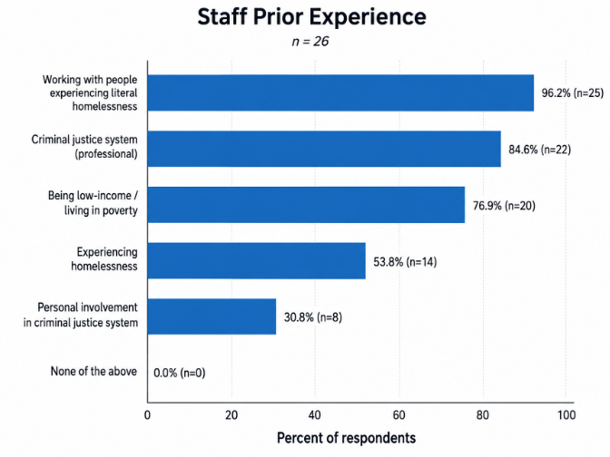
The staffing data suggest a workforce with substantial direct and relevant experience in homelessness services and related systems. Nearly all respondents had prior experience working with people experiencing literal homelessness, and large shares also reported professional experience with the criminal justice system and personal experience with poverty. Over half of respondents reported having experienced homelessness themselves, indicating that many staff bring both professional knowledge and lived experience to their work.
Key Takeaways
This project is part of a body of Alliance projects focused on investigating or evaluating promising practices that could improve the field’s effectiveness in serving clients and ending homelessness. Other organizations, systems, and policymakers can take away the following from the PDA model:
- Living wages, generous benefits package, and work supports provided by PDA are associated with high levels of employee job satisfaction and a desire to stay employed with the organization. Since homeless services are relationship-based, staff stability benefits clients. More employers should consider implementing such policies.
- The package of living wages and benefits used by the organization increases program costs. Since homeless services significantly rely on public funding, all levels of government (federal, state, and local) have a role to play in ensuring that a) agencies have adequate funding for such offerings and b) policies and procedures support (and don’t hinder) these uses of funds.
- Identifying mission-driven employees for hiring and retention may lead to better job satisfaction. Future efforts should focus on how PDA is successfully identifying mission-driven staff, a trait that is often valued in the non-profit sector. This may help others to replicate their outcomes.
- Relationships with clients and fellow staff are highly important. Organizations should investigate methods of supporting and enhancing positive relationships in services organizations, incorporating findings into job training and recruitment efforts.
- A willingness to experiment with workplace policies could lead to positive results, but also unintended negative consequences such as employee confusion and discontent. During planning processes, organizations should identify ways to reduce these byproducts of experimentation.
- More research is needed on how other organizations have implemented workforce policies to increase employee retention within homeless services. Such work would help determine if this project’s findings are typical or atypical. Additional research could focus on elements of PDA’s approach that may be relevant to job satisfaction but were not studied by this team—for example, limited caseloads and a team largely defined by mid-career professionals with highly relevant experience. Finally, more could be learned from policies and practices that are not implemented by PDA.
You might also be interested in


Stay Updated: Solutions, Stories, and Ways to Make an Impact
Sign up to receive updates on the Alliance’s work, including the latest research, advocacy efforts, and real stories of progress — plus ways you can help drive lasting change.