







Event Details
Event Details
Leadership Summit
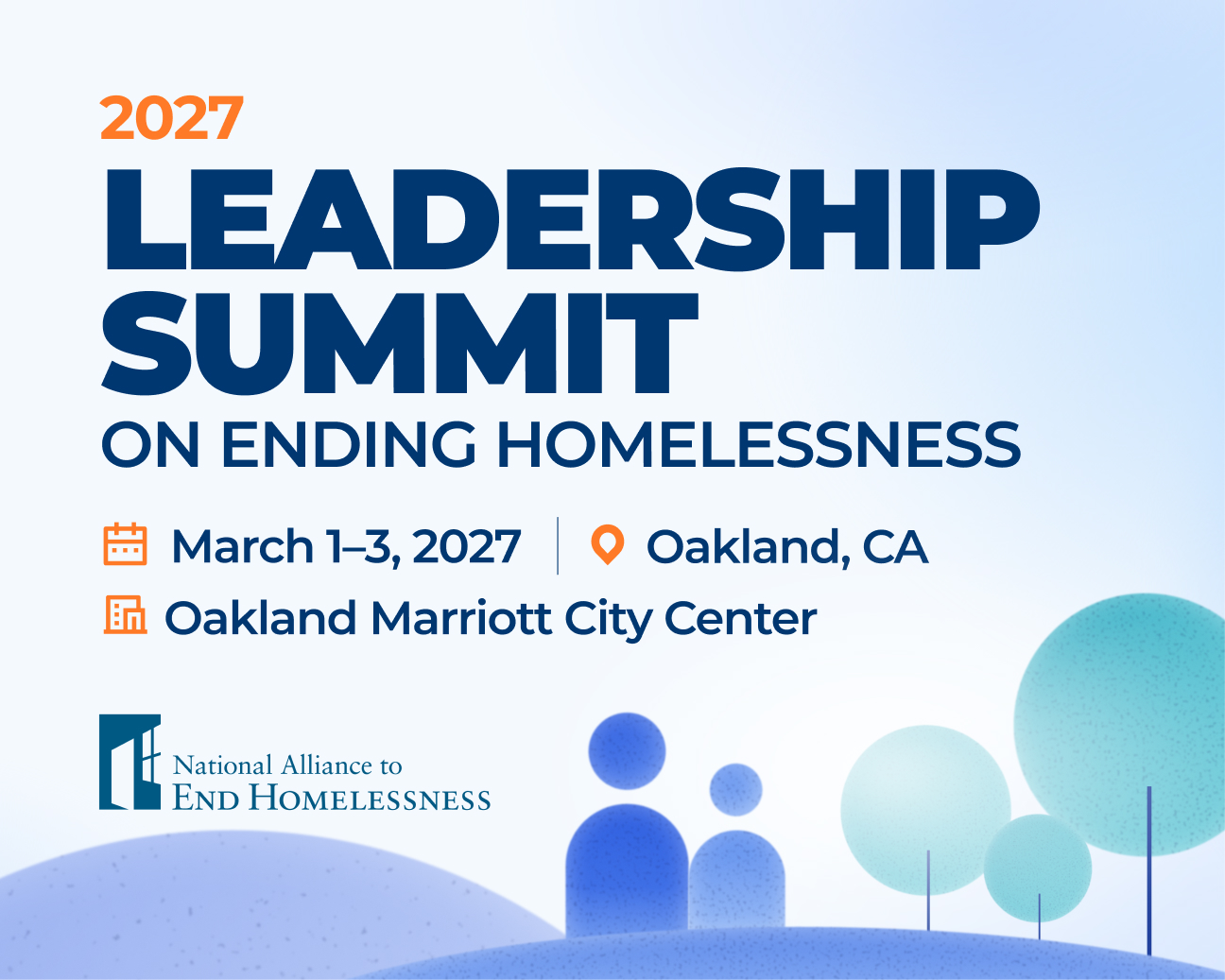
The 2027 Leadership Summit on Ending Homelessness brings together leaders from across the homelessness response system for meaningful connection, shared learning, and collaborative problem-solving.
Leaders across the field are navigating an increasingly complex environment—from funding uncertainty and workforce pressures to shifting public narratives, changing policy priorities, and growing need and demand for cross-sector collaboration. Meeting these challenges requires new approaches, stronger partnerships, and opportunities to learn from others confronting similar questions.
The Leadership Summit creates space to do that. Leaders from across roles, organizations, and communities will come together to exchange ideas and strategies, learn from one another, and strengthen the relationships needed to advance solutions to homelessness.
This year, the Summit is complemented by the new LEAD Institute, an optional pre-Summit experience offering focused professional development with peers in similar roles and leadership contexts.
New This Year: The LEAD Institute
(Optional Summit Add-On)
Before the Leadership Summit begins, the Alliance will host the new LEAD (Leadership, Equity, Action, and Direction) Institute on Monday, March 1, 2027, beginning at 9:00 A.M.
The LEAD Institute is an optional one-day professional development experience designed to give leaders dedicated time to strengthen their leadership practice, work through shared challenges, and build relationships with peers in similar roles.
The LEAD Institute requires an additional registration fee. Review the registration rates below for pricing details.
Choose Your Leadership Community
When registering for the LEAD Institute, participants will select the Leadership Community that best reflects their role and leadership context:
- Frontline Leaders
- Data Leaders
- System Leaders
- State and Local Government Leaders
- Emerging Leaders
- Executive Leaders
Participants will stay with their selected Leadership Community throughout the day. Each community’s programming is designed around the experiences and challenges of leaders in similar roles, creating space to build trust, dig into shared leadership challenges, and develop meaningful peer connections.
Because the sessions build on one another, participants will not be able to move between Leadership Communities.
Leadership Communities will also come together for three general sessions throughout the day, creating opportunities for broader learning and connection.
Not sure which Leadership Community is right for you? Review the Leadership Community descriptions before making your selection during registration.
Review the LEAD Institute agenda here to explore programming and session content for each Leadership Community.
Leadership Communities
All summit participants will be asked to select a leadership community at the time of registration. These communities reflect the different leadership roles that exist across the homelessness response system while providing sufficient commonality for meaningful peer learning.
This selection will not limit what workshops the registrant can attend during the Leadership Summit.
However, for those attending the optional LEAD Institute add-on, participants will remain in training with their community throughout the day and will not be able to attend the trainings for other communities during the Institute. Review the agenda here to review content by community for the LEAD Institute.
- Frontline Leaders: Provide direct care to unhoused individuals, including those who oversee staff and programs that provide housing navigation, case management, crisis intervention, and supportive services.
- Data Leaders: Generate and apply evidence to drive actionable solutions to end homelessness, ensuring that data, evaluation, and community knowledge inform systems and policy change.
- System Leaders: Coordinate regional homeless response systems (e.g., Continuums of Care), overseeing data, funding streams, and system performance aligned with federal, state, or local housing goals.
- State and Local Government Leaders: Hold elected, appointed, or administrative roles that shape policy, budgets, and legislation related to homelessness, housing, healthcare, and community development.
- Emerging Leaders: Step into new levels of influence. Includes rising leaders across sectors and early or mid-career professionals developing management skills, entering formal leadership roles, or growing their leadership identity.
- Executive Leaders: Guide organizations through strategic, operational, and cultural leadership. Often serve as executive directors, CEOs, or senior managers with organizational or multi-agency responsibilities.
NOTE: Reflective of past feedback, Lived Experience leaders will be integrated throughout each leadership community. Members of the Alliance’s lived experience Community Strategic Team (CST) are involved in overarching planning of both the Leadership Summit and LEAD Institute content.