








Download the Report
Summary and Introduction
In recent years, the Trump administration and other critics have painted the homeless services field as a “failure”. Negativity toward staff, Housing First, and permanent housing programs significantly rest on a single argument: if existing methods of addressing homelessness worked, the problem would no longer exist. Alliance analysis shows why this reasoning is faulty. Workers and their evidence-based methods are not the problem, but a decades-long pattern of underinvestment by Congress and other levels of government.
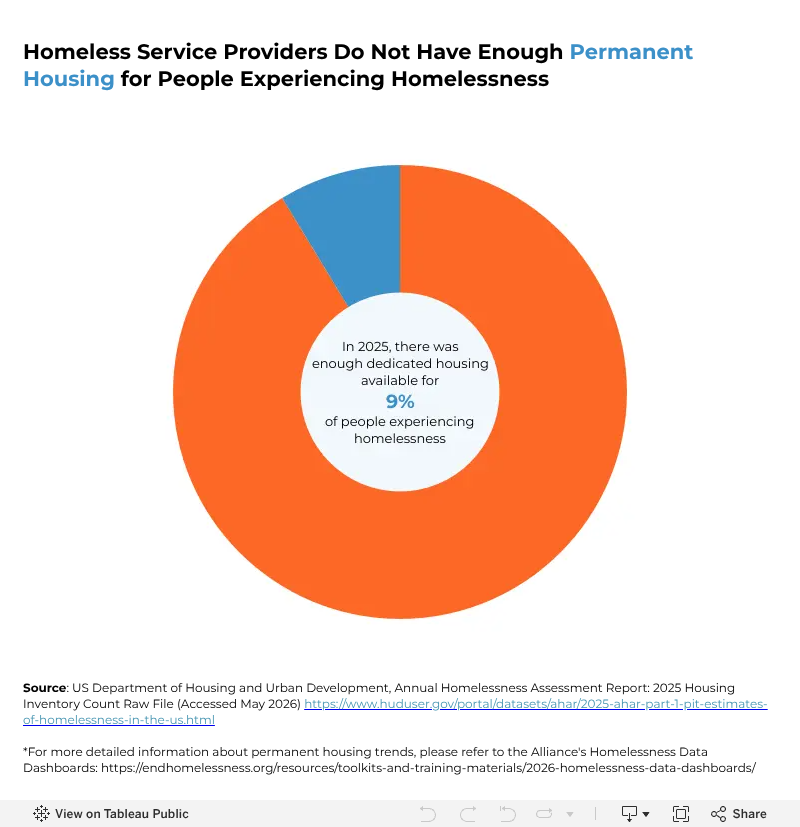
The Alliance found that, nationwide, these homeless response systems had enough permanent housing for just 9 percent of unhoused people and enough shelter for just 35 percent of unsheltered people.
America can end homelessness. Congress could choose to invest in homeless assistance programs for everyone in need. Required funding is not out of reach—the current budget for these programs amounts to only 0.5 percent of federal defense spending. Doubling or tripling spending in key areas would address massive shortages in permanent housing and shelter, helping to end homelessness.
Instead, the Alliance analysis finds that investments have remained stubbornly low compared to the need. With current funding amounts from Congress and other sources, service providers are regularly forced to manage permanent housing shortages, leaving many people literally out in the streets. Such results are visible to community members and state and local policymakers who incorrectly assume that homeless service providers are either failing to do their jobs or are trying to help people who can’t be helped. The Trump administration and other backers of limited government feed these narratives, using them to make suggestions that worsen housing shortages — for example, defunding or eliminating programs like Permanent Supportive Housing.
To responsibly address this crisis, policymakers and practitioners should rely on available data on shortages and invest in real solutions. The Shortage Report aims to inform these needed conversations.
There Are Massive Permanent Housing and Shelter Shortages
Across the country, local communities have CoCs that are funded by the federal government to develop organized approaches to addressing homelessness. They typically draw upon multiple funding sources, including from all levels of government and the private sector (e.g., foundations and businesses) to reach their goal of ending homelessness. Even when combining these various funding streams, in 2025, they fell far short of having enough resources to permanently house or shelter everyone in need of assistance.
On the night of the 2025 PiT Count, less than one percent of CoCs had enough permanent housing to rehouse everyone experiencing homelessness in their communities.
National-Level Shortages of Permanent Housing and Shelter
Permanent housing directly ends homelessness. However, on the night of the 2025 Point-in-Time (PiT) Count, CoCs nationwide had a critical shortage of permanent housing. These programs only had enough available for nine percent of people experiencing homelessness.[1] Thus, the goal of ending homelessness was completely out of reach.
When communities don’t have enough permanent housing for everyone who is homeless, temporary shelter helps keep people safe. However, communities do not have nearly enough shelter beds for everyone in need. At the time of the 2025 PiT Count, the nationwide number of open beds was only enough for 35 percent of people who were sleeping outside.[2] While critics sometimes accuse people experiencing homelessness of refusing help and services, far too many simply have no place to go.

Shortage Amounts Vary at the State and Local Levels
No state had homeless response systems with enough permanent housing for everyone experiencing homelessness at the time of the Count, and shortages varied widely. For example, Oklahoma had permanent housing for only one percent of its homeless population, while Minnesota had beds for 41 percent.
Drilling down to the local level, less than one percent of CoCs had enough permanent housing to end homelessness on the day of the 2025 PiT Count. And, again, the levels of shortage varied by jurisdiction. Research points to an important contributing factor —locations with higher housing costs tend to have higher rates of homelessness. This dynamic increases demand and strains the homeless response system’s capacity.
Variations in permanent housing shortages are rooted in state and local flexibility to make decisions based on their needs and priorities, as well as the varying amounts of public and private funding they receive. Still, the overall pattern is clear: across the country, no matter the path taken by state and local policymakers, available permanent housing resources were overwhelmingly insufficient to end homelessness.

Moving beyond permanent housing, most states and local jurisdictions also did not have enough open shelter beds for everyone experiencing homelessness on the day of the PiT Count. Some states and localities punish or criminalize unsheltered people for sleeping outside even when they have shelter beds available for just 25 or even 10 percent of people in need. Not only are these policies unfair to those who have no place to go, but available evidence indicates they are ineffective.

Finally, another important factor in understanding local variations in homeless assistance shortages is community type. Most people in America live in cities and urban areas. It is therefore not surprising that these communities have the largest overall number of people experiencing homelessness. Rural communities, on the other hand, have smaller homeless populations, but they tend to be more reliant on federal government resources and experience the greatest challenges when federal funding is cut or falls short. Still, all community types face large permanent housing and shelter shortages and need more resources from all levels of government.

Individuals Face the Greatest Shortages
During the 2025 PiT count, shelter shortages for individuals were more than twice as large as shortages for families. In this context, it is not surprising that 49 percent of individual adults experiencing homelessness sleep in tents, cars and public spaces, compared to just seven percent of people in families.
If lawmakers addressed shortages by expanding funding for shelter, permanent housing, and supportive services for individuals, communities could end unsheltered homelessness.
Shortages Have Always Existed
Homeless service organizations have never received enough federal funding to house everyone. Since data reporting began nearly two decades ago, there have always been large gaps between the number of people who are homeless and the amount of available permanent housing and shelter.
While communities could permanently house just 9 percent of people experiencing homelessness during the 2025 PiT Count, historically that number has tended to be even lower. The highest peak occurred in 2022 with communities being able to permanently house 12 percent of people at the time of that year’s PiT Count. However, that relatively modest jump required an extraordinary event: the Covid-19 pandemic. In response to the crisis, Congress temporarily increased investments in a broad list of anti-poverty programs that included homeless services. Unfortunately, Congress did not sustain this funding, and shortages increased again. Given this historical pattern, ending homelessness has been impossible.

Over time, the shortage of temporary shelter beds has also been consistently large (although not as severe as those for permanent housing). In 2015, the nation’s shelters only had enough open beds for 35 percent of unsheltered people, fitting with historical patterns. The trend disproves the stereotype that massive numbers of people are simply refusing to go inside and must be forced into services.

Federal Funding Does Not Meet the Need
More federal funding is necessary for communities to end homelessness. Congress generally approves small, annual increases in Homelessness Assistance Grants (or HAG), which includes the CoC Program and the Emergency Solutions Grants Program (ESG). These increases are helpful, but they barely keep up with inflation, let alone large increases in the number of people who need assistance. This leads to persistent permanent housing and shelter shortages. After adjusting for inflation, funding for these programs only increased 43 percent from 2016 to 2026. In 2022, annual funding per person was just $1,829 — less than one month of rent in many places.
Because Congress underfunds HAG programs, CoCs and homeless service providers piece together multiple funding sources, including private donors, state and local governments, as well as other federal grant programs that contribute to state and local homelessness budgets. Even when combined, these funding sources fail to meet the demand for homeless services, leaving large numbers of people without housing, shelter and/or services.
The limitations of these Congressional funding increases are illustrated in the visualizations below. According to the Alliance’s analysis, during each year’s PIT Count, federal HAG funds are consistently able to fund permanent housing for a mere 2 percent of people experiencing homelessness. The funds are only able to shelter less than 15 percent of people living unsheltered. As the visualizations below illustrate, the negative consequences of limited federal appropriations are being compounded by the following:
- Increases in Homelessness. More and more people are experiencing homelessness for the first time. Even as providers successfully housed more people, many more new people entered their doors seeking assistance between 2016 and 2024 (See the blue bars on each visualization below). When there are more people to serve, investments have less impact.
- Administrative Burdens of Non-HAG Funds. Communities regularly secure funding from non-HAG sources, including from state and local governments, private foundations and donors, and other federal programs. Those sources help them serve far more people than HAG will allow but dramatically increase the administrative burdens on systems and providers that must apply (and follow requirements) for several different funding streams (Compare the orange and yellow bars on each visualization below). It is more efficient for communities to have a single, reliable funding source.
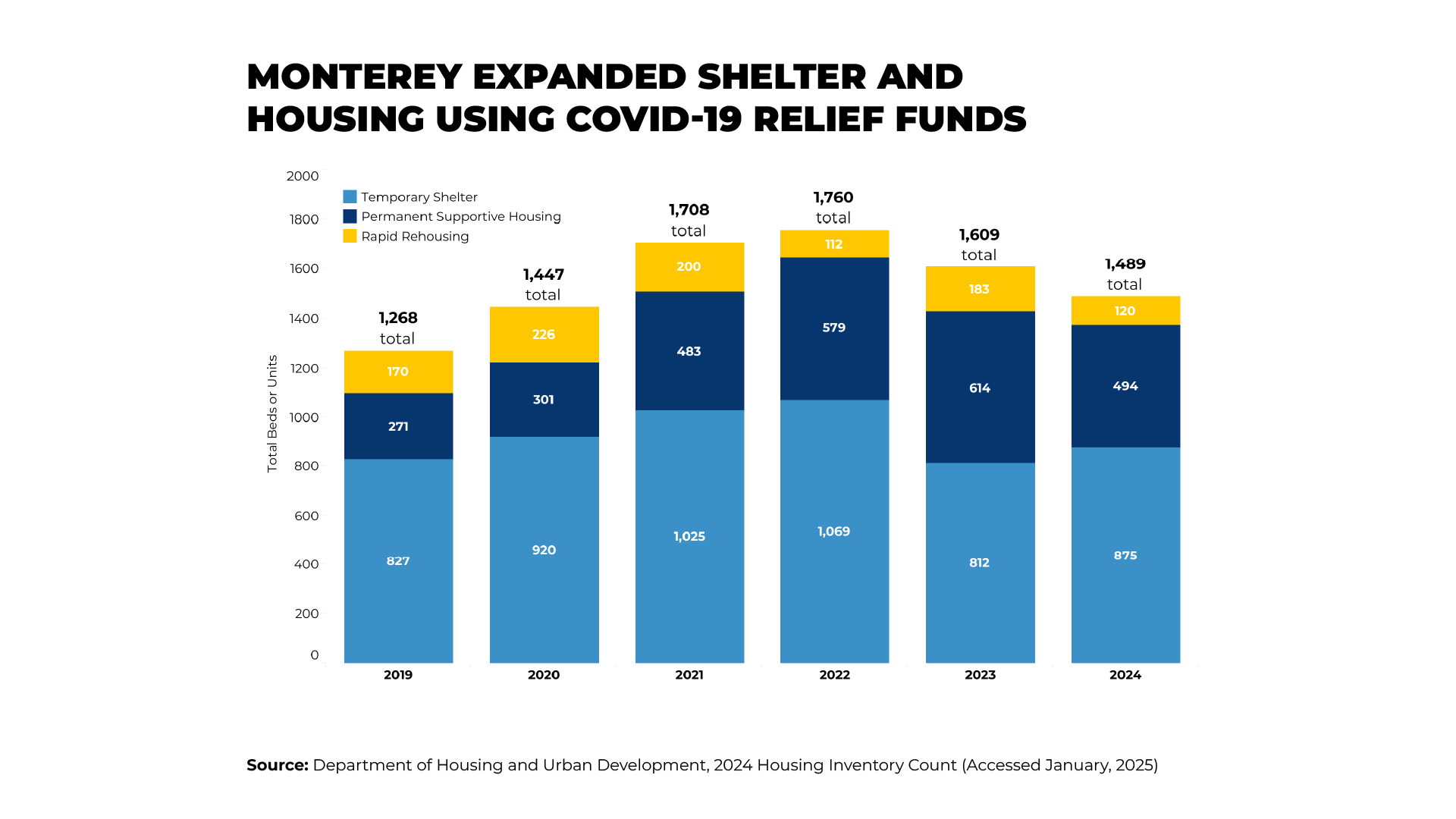
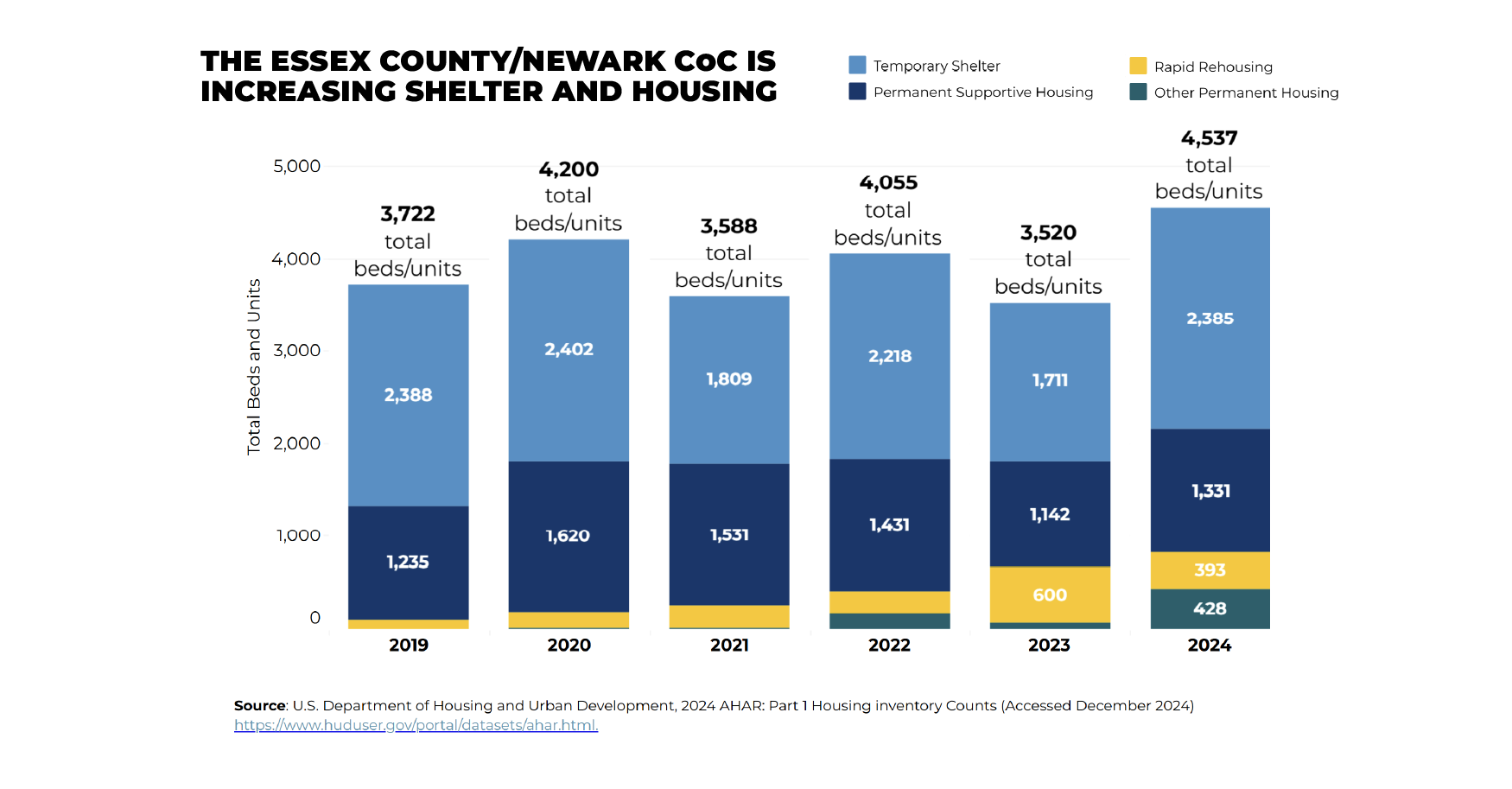
- Expiration of Covid-19 Relief. Between 2020 and 2022, federal Covid-19 relief boosted the number of people who could benefit from permanent housing and shelter. Since that time, the nation has been seeing a retreat in those numbers, creating a new crisis.

It is estimated that an additional 9.6 billion dollars in annual funding for HAG could provide everyone currently staying in a shelter with permanent housing and services. This increase would more than triple current federal spending (4.4 billion dollars) on the homeless response system. While it is true that this would be a drastic increase, it is also true that ending homelessness is inexpensive relative to other federal programs. Funding for HAG in FY26 was just half of one percent of Defense funding.

Monumental increases in HAG funding are critically needed to prevent and end homelessness. To reduce the number of people in need of homeless services, Congress must also invest in a wide range of social safety net programs that help people manage living costs and remain stably housed. Across income brackets, housing, healthcare and even food costs remain deeply unaffordable, impacting vulnerable and low-income people the most. A range of federal programs, including housing vouchers and Medicaid, help such people pay for these necessities but are also underfunded. Fully funding these programs (alongside homeless services) would reduce the number of people experiencing a housing crisis and allow homeless service providers to serve a greater share of people experiencing homelessness.
Conclusion
Homeless service providers are expected to do the impossible: end homelessness despite persistent shortages of both permanent housing and shelter. Homeless service providers know how to help people experiencing homelessness and need Congress to robustly support their efforts.
This will cost money but is inexpensive relative to other federal spending priorities. Investing in homeless services also offers a good return on investment by creating more prosperous, safe and productive communities. It keeps people experiencing homelessness safe while they find a place to live.
Congress can end homelessness in America. It needs to make the decision to respond to these shortages and fund real solutions.
How Does the Alliance Estimate Housing and Shelter Capacity Shortages?
The Alliance estimates housing capacity shortages based on the number of Permanent Supportive Housing, Rapid Re-Housing and Other Permanent Housing beds (collectively referred to as “permanent housing” or “housing”) that are dedicated for people experiencing homelessness and unoccupied. This count of available beds is compared to the number of people experiencing homelessness during the annual Point in Time count.
The Alliance estimates shelter capacity shortages based on the number of Emergency Shelter, Transitional Housing and Safe Haven beds (collectively referred to as “temporary shelter” or “shelter”) that are unoccupied and potentially available for unhoused people living unsheltered during the annual Point in Time count. Many of these are “seasonal beds” and only available for a short period of time during the winter months. Many beds are also only available briefly because people leave and reenter shelter. At times, shelter beds can also be located at a distance from a person’s community or work or have other rules that make them inaccessible. These trends suggest that in many communities, the shortage of accessible beds is more extreme than the data indicate.
The Alliance also determines the share of these beds that are funded by federal Homelessness Assistance Grants, the country’s largest source of funding for homelessness programs. For each of these calculations, the Alliance uses data from the Department of Housing and Urban Development’s Housing Inventory Count and Point in Time Count.
[1] Permanent housing includes Permanent Supportive Housing (PSH), Rapid Rehousing and Other Permanent Housing (OPH) counted in HUD’s annual “Housing Inventory Count.”
[2] Many of these beds are only available for a short period of time as people leave and reenter shelter. At times, they are located at a distance from a person’s community or work, making them inaccessible. This suggests that in many communities, the shortage of accessible beds is more extreme than the data indicate. Further, some shelters erect barriers to participation that leave some beds empty.
You might also be interested in


Stay Updated: Solutions, Stories, and Ways to Make an Impact
Sign up to receive updates on the Alliance’s work, including the latest research, advocacy efforts, and real stories of progress — plus ways you can help drive lasting change.